Bergen-Belsen
Concentration camp, 1943–1945. Today Bergen-Belsen (near Bergen, north of Celle), Germany.
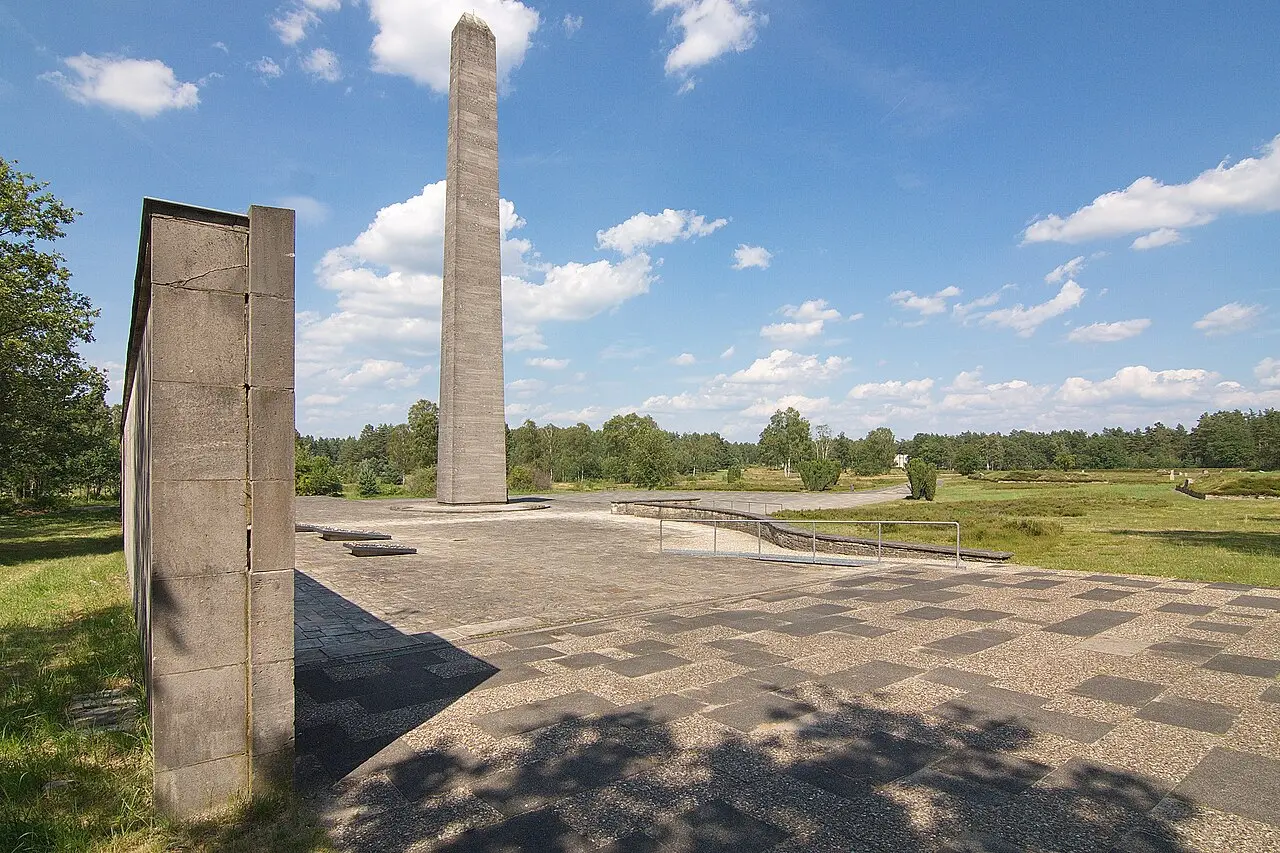
Bergen-Belsen, about 11 miles north of Celle in northern Germany, began in 1940 as a camp for prisoners of war. In April 1943 the SS took over part of the site and set up the "Aufenthaltslager" (residence camp) Bergen-Belsen, a concentration camp initially intended for Jews whom the SS and the German Foreign Office wanted to hold as hostages, to be exchanged for Germans interned abroad or for foreign currency or goods. Between July 1943 and December 1944 at least 14,600 Jewish prisoners, including 2,750 children and young people, were brought to this exchange camp, which was divided into sections such as the "Sternlager" (star camp), the "Ungarnlager", the "Sonderlager" for Polish Jews and the "Neutralenlager". According to the memorial, only about 2,560 of these Jewish prisoners reached freedom.
From spring 1944 the SS also used Bergen-Belsen for male prisoners from other concentration camps who were no longer able to work, and from August 1944 for a women's camp. From December 1944 it became the destination of evacuation transports and death marches from camps near the front: at least 85,000 men, women and children were brought there on more than 100 transports and marches. Catastrophic overcrowding, hunger and epidemics of typhus followed; in March 1945 alone more than 18,000 people died. Among the dead were Margot and Anne Frank, who died there in March 1945.
British troops liberated the camp on 15 April 1945, finding around 55,000 prisoners (USHMM). According to the Bergen-Belsen Memorial, more than 52,000 of the roughly 120,000 prisoners died there; the USHMM gives a total of approximately 50,000. The Arolsen Archives count at least 36,400 prisoners who died of hunger, thirst, cold and disease and a further 13,944 who died of the consequences of their imprisonment.
From Berlin
Bergen-Belsen was not a regular destination of the deportation trains from Berlin. The only Berlin transport linked to it in the transport lists is the 61st "Osttransport" of 5 January 1945, with 20 people, whose destination the Statistik des Holocaust list gives as "Ravensbrück/Sachsenhausen/Bergen-Belsen"; the Arolsen Archives, by contrast, describe the 60th and 61st transports as going to Sachsenhausen, with the women sent on to Ravensbrück. The exchange camp's "Sternlager" held, among others, Jews from the German Reich, and from December 1944 evacuation transports brought prisoners from many camps to which Berlin Jews had earlier been deported. The sources consulted, however, give no figures for Berlin Jews among the prisoners of Bergen-Belsen.
No transport went directly from Berlin to this place.
The memorial today
The Bergen-Belsen Memorial, inaugurated in November 1952 with an obelisk and inscription wall beside the mass graves, has had a documentation centre with a permanent exhibition, archive and library since 2007.
Sources
- Gedenkstätte Bergen-Belsen: Konzentrationslager Bergen-Belsen 1943–1945 SS takeover April 1943; exchange camp purpose and sections; at least 14,600 Jewish prisoners incl. 2,750 children; about 2,560 freed; men's camp 1944, women's camp August 1944; at least 85,000 brought from December 1944; more than 18,000 deaths in March 1945; liberation 15 April 1945; more than 52,000 of 120,000 died; Margot and Anne Frank
- Gedenkstätte Bergen-Belsen: Die Toten des Konzentrationslagers At least 52,000 of 120,000 prisoners died; destruction of camp records
- Gedenkstätte Bergen-Belsen: Geschichte der Gedenkstätte Memorial inaugurated November 1952 (obelisk, inscription wall); documentation centre opened 2007
- USHMM Holocaust Encyclopedia: Bergen-Belsen Location north of Celle; POW camp from 1940; around 55,000 prisoners found at liberation on 15 April 1945; approx. 50,000 total deaths
- Arolsen Archives: Concentration Camp Bergen-Belsen (1.1.3) 'Star camp' held Jews from the Netherlands, France, North Africa, Albania and the German Reich; at least 36,400 deaths plus 13,944 from the consequences of imprisonment
- Statistik des Holocaust: Deportationslisten Berlin 61st Osttransport, 5 January 1945, 20 people, destination 'Ravensbrück/Sachsenhausen/Bergen-Belsen'
- Arolsen Archives: Deportations from Berlin (1.2.1.1, VCC 155 I) 60th and 61st Osttransporte went to Sachsenhausen, women sent on to Ravensbrück
- Wikipedia: Bergen-Belsen concentration camp coordinates