Auschwitz (Auschwitz II-Birkenau)
Concentration camp, extermination camp, 1940–1945. Today Oświęcim, Poland.
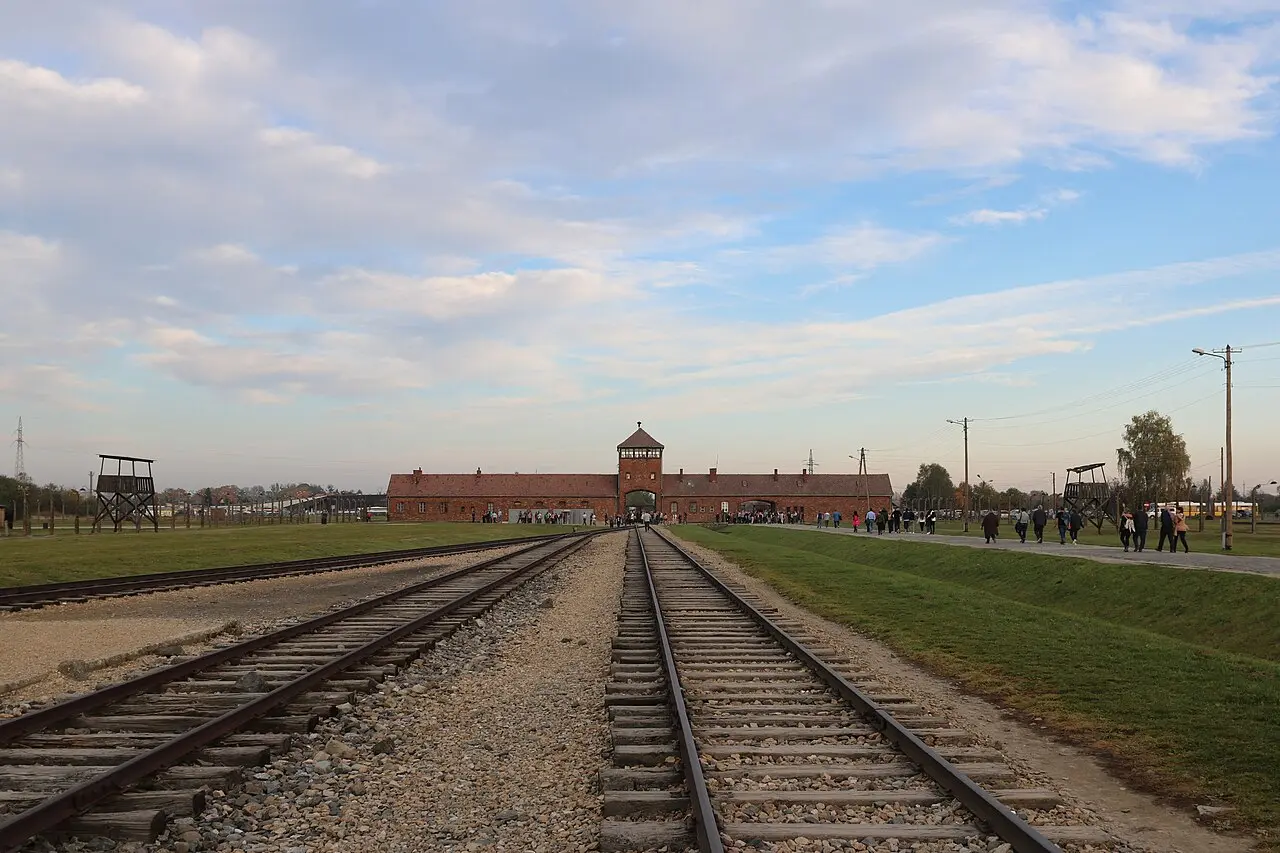
Auschwitz was the largest concentration camp run by the SS and the largest site of the immediate, direct murder of Jews. It was set up in 1940 on the outskirts of the Polish town of Oświęcim, in territory annexed to the German Reich after the invasion of Poland. It was originally established for Polish prisoners, who were its first political prisoners; in 1941 about 10,000 Soviet prisoners of war and more than 1,000 Jews were also registered there.
From March 1942 the second camp, Auschwitz II-Birkenau, functioned both as a concentration camp and as a killing centre. On arrival, SS personnel subjected the deportees to a "selection": a minority judged fit for work were registered as prisoners and forced to labour under conditions few survived, while most – among them children, the elderly and the sick – were taken directly to the gas chambers and murdered. According to the Auschwitz Memorial, almost 1.1 million Jews were deported to the camp between 1942 and 1944, of whom about 200,000 were registered as prisoners.
The United States Holocaust Memorial Museum (USHMM) estimates that approximately 1.1 million people were murdered at Auschwitz, about one million of them Jews; the other victims included 70,000–75,000 non-Jewish Poles, about 21,000 Roma and more than 14,000 Soviet prisoners of war. From 17 January 1945 the SS drove tens of thousands of prisoners, most of them Jews, on death marches. Soviet troops liberated the camp on 27 January 1945 and found about 7,000 prisoners still alive. The coordinates given here mark Auschwitz II-Birkenau, where most Berlin deportees were murdered.
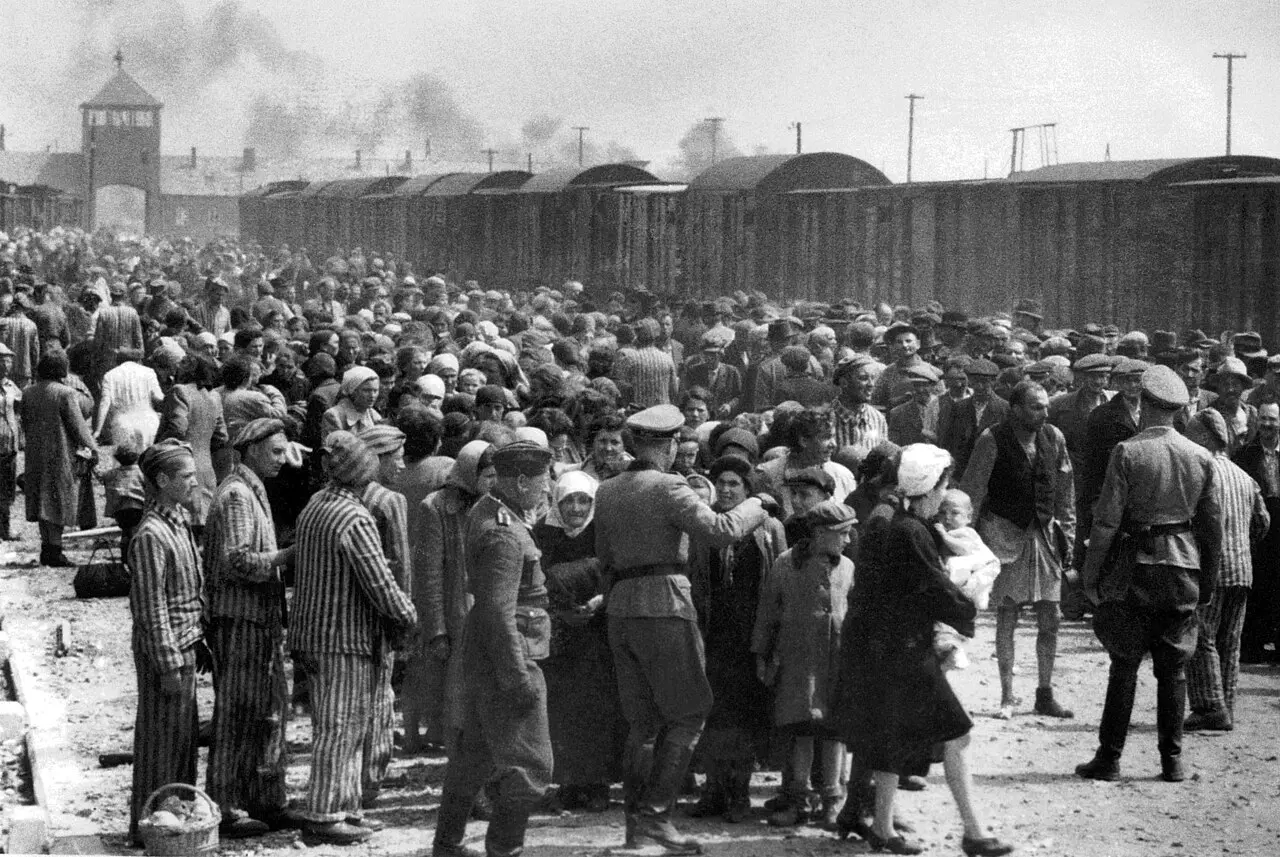
From Berlin
From late 1942 Auschwitz was the main destination of the deportations from Berlin. An earlier, smaller transport – the 17th, which left Berlin on 11 July 1942 with about 200 people (210 according to the Statistik des Holocaust list, 192 according to the list published by the Charlottenburg-Wilmersdorf district office) – is linked by a handwritten note on the Berlin transport list to a Hamburg transport to Auschwitz; its destination was long disputed, and Warsaw has also been suggested. Because no prisoner numbers were issued for it in Auschwitz, it is assumed that all of its deportees were murdered on arrival. From the 23rd "Osttransport" of 29 November 1942 – about 1,000 people, including 36 children from the Auerbach orphanage in Prenzlauer Berg, of whom only one deportee is known to have survived – every regular "Osttransport" from Berlin went to Auschwitz, up to the 58th on 12 October 1944: 36 transports in all, most of them leaving from the Moabit freight station on Putlitzstraße. Added together, the per-transport figures in the Statistik des Holocaust list come to about 18,300 people. Among those murdered on arrival was the children's author Else Ury, deported on the 26th transport of 12 January 1943.
The largest transports came after the "Fabrikaktion", the mass arrest of Jews still doing forced labour in Berlin factories that began on 27 February 1943 (8,000 to 11,000 people were arrested, according to the Berlin-Mitte district office). Between 1 and 12 March 1943 six transports carrying between about 660 and 1,760 people each left Berlin for Auschwitz – almost 8,000 people in all, adding up the per-transport figures in the Statistik des Holocaust list. From the 33rd transport (3 March 1943, 1,726 people), for example, the SS selected 517 men and 200 women for forced labour and murdered 1,033 people on arrival, according to the Auschwitz chronicle cited by Yad Vashem. From mid-1943 the transports were small – often fewer than 50 people – and carried Jews who had been caught in hiding, partners in so-called "mixed marriages" who had lost their protection and, occasionally, prisoners taken from jails. Very few of the deportees survived: for the individual Berlin transports documented by Yad Vashem, the number of known survivors ranges from none (for example the 25th and 27th transports) to 28 (the 33rd).
37 transports from Berlin brought 18,506 people here; at least 241 of them are known to have survived.
Transports from Berlin to Auschwitz
| Date | Designation | From | People | Known survivors |
|---|---|---|---|---|
| 11.07.1942 | XVII. Teiltransport | Güterbahnhof Moabit | 210 | |
| 29.11.1942 | 23. Osttransport | Güterbahnhof Moabit | 1,001 | 1 |
| 09.12.1942 | 24. Osttransport | Güterbahnhof Moabit | 1,000 | 2 |
| 14.12.1942 | 25. Osttransport | Güterbahnhof Moabit | 811 | 0 |
| 12.01.1943 | 26. Osttransport | Güterbahnhof Moabit | 1,190 | 2 |
| 29.01.1943 | 27. Osttransport | Güterbahnhof Moabit | 1,000 | 0 |
| 03.02.1943 | 28. Osttransport | Güterbahnhof Moabit | 952 | 5 |
| 19.02.1943 | 29. Osttransport | Güterbahnhof Moabit | 1,000 | 6 |
| 26.02.1943 | 30. Osttransport | Güterbahnhof Moabit | 1,100 | 11 |
| 01.03.1943 | 31. Osttransport | Güterbahnhof Moabit | 1,736 | 12 |
| 02.03.1943 | 32. Osttransport | Güterbahnhof Moabit | 1,758 | 26 |
| 03.03.1943 | 33. Osttransport | Güterbahnhof Moabit | 1,731 | 28 |
| 04.03.1943 | 34. Osttransport | Güterbahnhof Moabit | 1,142 | 14 |
| 06.03.1943 | 35. Osttransport | Güterbahnhof Moabit | 662 | 9 |
| 12.03.1943 | 36. Osttransport | Güterbahnhof Moabit | 947 | 13 |
| 19.04.1943 | 37. Osttransport | Güterbahnhof Moabit | 688 | 26 |
| 17.05.1943 | 38. Osttransport | Güterbahnhof Moabit | 395 | 5 |
| 28.06.1943 | 39. Osttransport | Not documented | 317 | 25 |
| 04.08.1943 | 40. Osttransport | Not documented | 99 | 2 |
| 24.08.1943 | 41. Osttransport | Not documented | 50 | 3 |
| 10.09.1943 | 42. Osttransport | Not documented | 52 | 2 |
| 28.09.1943 | 43. Osttransport | Not documented | 74 | 2 |
| 14.10.1943 | 44. Osttransport | Not documented | 74 | 1 |
| 29.10.1943 | 45. Osttransport | Not documented | 49 | 0 |
| 08.11.1943 | 46. Osttransport | Not documented | 50 | 2 |
| 07.12.1943 | 47. Osttransport | Not documented | 55 | 1 |
| 20.01.1944 | 48. Osttransport | Not documented | 48 | 2 |
| 22.02.1944 | 49. Osttransport | Not documented | 32 | 3 |
| 09.03.1944 | 50. Osttransport | Not documented | 32 | 1 |
| 18.04.1944 | 51. Osttransport | Not documented | 30 | 6 |
| 03.05.1944 | 52. Osttransport | Not documented | 30 | 4 |
| 19.05.1944 | 53. Osttransport | Not documented | 24 | 3 |
| 15.06.1944 | 54. Osttransport | Not documented | 29 | 6 |
| 12.07.1944 | 55. Osttransport | Not documented | 30 | 4 |
| 10.08.1944 | 56. Osttransport | Not documented | 38 | 5 |
| 06.09.1944 | 57. Osttransport | Not documented | 39 | 6 |
| 12.10.1944 | 58. Osttransport | Not documented | 31 | 3 |
The memorial today
The Auschwitz-Birkenau State Museum, created by an act of the Polish parliament on 2 July 1947, preserves the grounds of Auschwitz I and Auschwitz II-Birkenau as a memorial and museum.
Sources
- Auschwitz-Birkenau State Museum: Auschwitz and Shoah Largest Nazi concentration camp and largest centre for the direct extermination of Jews; operated 1940–1945
- Auschwitz-Birkenau State Museum: The number of victims Camp set up for Poles; 1941 registrations; almost 1.1 million Jews deported 1942–1944; about 200,000 registered
- Auschwitz-Birkenau State Museum: History of the Memorial Museum created by act of the Polish parliament on 2 July 1947; includes Auschwitz I and II-Birkenau
- USHMM Holocaust Encyclopedia: Auschwitz Location in annexed territory near Oświęcim; Birkenau killing centre from March 1942; approx. 1.1 million murdered incl. victim groups; death marches from 17 January 1945; liberation 27 January 1945 with about 7,000 prisoners
- Statistik des Holocaust: Deportationslisten Berlin Berlin transport list: 17th transport (210), 23rd–58th Osttransporte to Auschwitz with per-transport figures (summed here: 18,297 for transports 23–58; 7,977 for the six March 1943 transports 31–36)
- Statistik des Holocaust: XVII. Teiltransport (11.7.1942) Disputed destination (Warsaw or Auschwitz); note linking it to Hamburg–Auschwitz transport; no prisoner numbers issued, so all presumed murdered on arrival
- Bezirksamt Charlottenburg-Wilmersdorf: Liste der Deportationszüge aus Berlin von 1941 bis 1945 (after Gottwaldt/Schulle) Alternative figure for 17th transport (192, 'Warschau oder Auschwitz'); transports 23–58 to Auschwitz; departures from Moabit
- Yad Vashem: Transport 23 from Berlin to Auschwitz Birkenau, 29/11/1942 998 deportees incl. 36 children of the Auerbach orphanage; departure from Putlitzstraße (Moabit); one known survivor
- Yad Vashem: Transport 25 from Berlin to Auschwitz Birkenau, 14/12/1942 No deportee known to have survived
- Yad Vashem: Transport 26 from Berlin to Auschwitz Birkenau, 12/01/1943 Else Ury murdered on arrival
- Yad Vashem: Transport 27 from Berlin to Auschwitz Birkenau, 29/01/1943 No deportee known to have survived
- Yad Vashem: Transport 33 from Berlin to Auschwitz Birkenau, 03/03/1943 1,726 deportees; 517 men and 200 women selected for labour, 1,033 murdered on arrival (per Danuta Czech); 28 known survivors
- Yad Vashem: Transport 36 from Berlin to Auschwitz Birkenau, 12/03/1943 Survivor testimony on the selection: children, sick and elderly sent to the gas chambers
- Yad Vashem: Transport 40 from Berlin to Auschwitz Birkenau, 04/08/1943 Composition of the later small transports (Jews in hiding, partners in 'mixed marriages', prisoners from jails)
- Bezirksamt Mitte: 27. Februar – Gedenken an die Fabrik-Aktion von 1943 Fabrik-Aktion began 27 February 1943; 8,000 to 11,000 arrested
- Wikipedia: Auschwitz concentration camp coordinates (point within Auschwitz II-Birkenau)

_1b.jpg)