Minsk (Ghetto)
Ghetto, 1941–1943. Today Minsk, Belarus.
The Wehrmacht occupied Minsk, the capital of Soviet Belarus, at the end of June 1941. In late July 1941 the Germans set up a ghetto in the north-western part of the city. Estimates of how many people were confined there differ. USHMM gives about 80,000, including Jews from nearby towns, and Yad Vashem about 100,000. Research cited by the GedenkstättenForum suggests 45,000–60,000.
From August 1941 the German authorities repeatedly carried out mass killings of the ghetto's inhabitants. To make room for Jews deported from the Reich, about 7,000 ghetto inmates were murdered between 6 and 11 November 1941 and at least 5,000 more on 20 November. The deportees were housed in separate “Sonderghettos”, with little contact allowed with the Belarusian Jews. On 2–3 March 1942 several thousand ghetto residents were shot at the site now known as “Yama” (the Pit). Between 28 and 31 July 1942 Security Police and SD units murdered nearly 10,000 people classed as “arbeitsunfähig” (“unfit for work”). For the first time, this massacre also included inmates of the “Sonderghettos”.
Between November 1941 and October 1942 nearly 24,000 Jews from Germany, Austria and the Protectorate of Bohemia and Moravia were deported to Minsk. From May 1942 most of them were no longer admitted to the ghetto but were murdered on arrival at nearby Maly Trostenets. In autumn 1943 the Germans liquidated the ghetto. Some inmates were deported to the Sobibor killing centre, and about 4,000 were murdered at Maly Trostenets. When Minsk was liberated in July 1944, only a few Jews had survived.
From Berlin
Berlin's fifth deportation transport (train Da 54, “Welle V”) left Bahnhof Grunewald on 14 November 1941. Its passengers had first been held in the Levetzowstraße synagogue. Sources put its size at 956 to 1,030 people. The train travelled via Warsaw and reached Minsk on 18 November 1941. The Berliners were housed in “Sonderghetto II”, in homes whose Belarusian Jewish inhabitants had been shot on 20 November 1941. The Reich Jews in the “Sonderghettos” were among the victims of the July 1942 massacre and of the final liquidation of the ghetto in October 1943. Of the roughly 1,000 Berlin Jews deported to the Minsk ghetto, only three men and one woman are known to have survived.
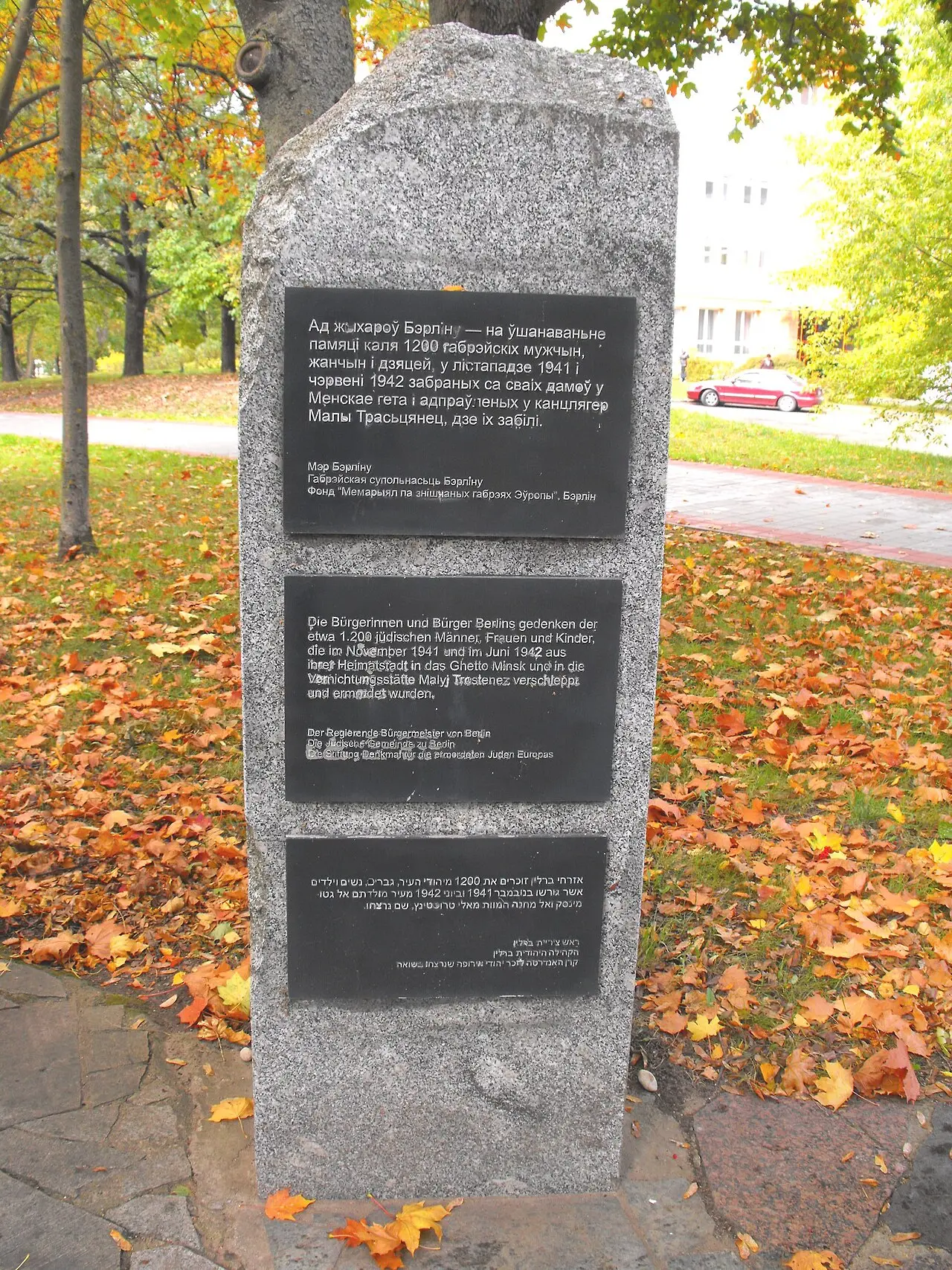
A second Berlin transport of about 200 people left in June 1942 and was probably joined at Königsberg to a train bound for Minsk. Its passengers were murdered at Maly Trostenets on arrival; see that entry. In 2009 the State of Berlin and the Stiftung Denkmal für die ermordeten Juden Europas unveiled a memorial stone on the former Jewish cemetery at the edge of the former ghetto. It commemorates about 1,200 Berlin Jews deported in November 1941 and June 1942 to Minsk and Maly Trostenets and murdered there.
1 transport from Berlin brought 1,030 people here.
Transports from Berlin to Minsk
| Date | Designation | From | People | Known survivors |
|---|---|---|---|---|
| 14.11.1941 | V. Transport | Bahnhof Grunewald | 1,030 |
The memorial today
The “Yama” memorial marks the site of the March 1942 massacre. Its post-war obelisk has an inscription in Russian and Yiddish, and in 2000 the bronze sculpture group “The Last Way” was added. Memorial stones for Jews deported from German and Austrian cities, among them one for the Berlin deportees (2009), stand on the former Jewish cemetery.
Sources
- USHMM Holocaust Encyclopedia: Minsk Ghetto established late July 1941; about 80,000 people; killings from August 1941; nearly 24,000 Reich/Protectorate Jews deported Nov 1941–Oct 1942, most killed at Maly Trostinets; separate ghetto section; liquidation fall 1943, deportations to Sobibor, 4,000 killed at Maly Trostinets
- Yad Vashem: Minsk – Historical Background during the Holocaust Occupation June 1941; ghetto with 100,000 Jews; separate ghetto for German Jews; liquidation fall 1943; only a few Jews survived to liberation in July 1944
- Anja Reuss / Kristin Schneider: Das Ghetto Minsk und die Vernichtungsstätte Maly Trostenez (GedenkstättenRundbrief 174, GedenkstättenForum) 45,000–60,000 confined (after Rentrop); massacres of 6–11 and 20 November 1941 and Sonderghetto I/II; July 28–31, 1942 massacre of nearly 10,000; October 1943 liquidation; 3 men and 1 woman of the Berlin deportees survived; ca. 200 Berliners in June 1942 via Königsberg to Maly Trostenez
- Yad Vashem, Transports to Extinction: Transport, Train Da 54 from Berlin to Minsk, 14/11/1941 Levetzowstraße assembly camp; Grunewald; 956–1,030 deportees; route via Warsaw; arrival 18 November 1941; ghetto for Reich Jews
- Bezirksamt Charlottenburg-Wilmersdorf (berlin.de): Liste der Deportationszüge aus Berlin von 1941 bis 1945 (after Gottwaldt/Schulle 2005) Transport 5: 14.11.1941 from Grunewald, 956 (1030), arrival 18.11.1941 Minsk; transport 16: 24.06.1942, 202 people, Minsk
- trostenez.org (IBB): Maly Trostenets Extermination Site – History and Remembrance (exhibition) Wehrmacht occupied Minsk at end of June 1941 after the air raids of 24–26 June
- Stiftung Denkmal für die ermordeten Juden Europas: Gedenkstein in Minsk enthüllt Memorial stone unveiled 25 June 2009 on the former Jewish cemetery for ca. 1,200 Berlin Jews deported in Nov 1941 and June 1942
- Centropa Audiowalks: The Pit Memorial / “Yama” Shootings of 2–3 March 1942; obelisk with Russian and Yiddish inscription; 'The Last Way' sculpture added in 2000
- Wikipedia: Minsk Ghetto coordinates