Raasiku bei Reval
Killing site, concentration camp, 1942–1943. Today Raasiku / Kalevi-Liiva (near Tallinn), Estonia.
Raasiku is a railway station about 35 kilometres from Tallinn (German: Reval) in German-occupied Estonia. In September 1942 two deportation trains from Central Europe were unloaded there: on 5 September a transport of 1,002 Jews from the Theresienstadt ghetto (the Jewish Museum in Prague counts 1,001 people on transport "Be", which left Terezín on 1 September), and on 30 September a transport with 1,049 Jews from Frankfurt am Main and Berlin (other sources give 1,089).
At the station, officers of the Security Police selected about 400 younger people for forced labour in the nearby Jägala camp. The others – nearly 1,600 people from the two trains – were taken by bus to the sand dunes of Kalevi-Liiva, a military training ground, and shot there by Estonian police under German authority. Jägala prisoners who fell ill or were accused of disobedience were later also shot at Kalevi-Liiva, as were local Roma. Attempts were made to conceal the crime, and in 1944 the bodies were burned; the mass graves were found only in 1961.
The Jägala camp was closed on 1 September 1943 and its remaining prisoners were moved to Tallinn Central Prison. Of the more than 2,000 Jews brought there in September 1942, only 74 are known to have survived the war. Estimates of the total number of people murdered at Kalevi-Liiva vary; the Jewish Community of Estonia gives between 3,000 and 6,000.
From Berlin
On 26 September 1942 the 20th Berlin "Osttransport" left the Moabit freight station after the deportees had been held in the assembly camp in the Levetzowstraße synagogue. It carried 812 Berlin Jews according to the Historische Kommission zu Berlin (809 according to statistik-des-holocaust.de), joined by 237 (or 234) Jews from Frankfurt am Main; among them were many families with children. Travelling via Riga, the train reached Raasiku on 30 September 1942.
At Raasiku only a small group – according to the Historische Kommission about 100 to 150 women and 50 men – was selected for the Jägala camp; the great majority were driven by bus to the dunes of Kalevi-Liiva and shot immediately after arrival. Very few of the Berlin deportees survived; one of them, Helga Drexler, endured several camps and escaped during a forced evacuation westward in January 1945.
1 transport from Berlin brought 809 people here.
Transports from Berlin to Raasiku bei Reval
| Date | Designation | From | People | Known survivors |
|---|---|---|---|---|
| 26.09.1942 | 20. Osttransport | Güterbahnhof Moabit | 809 |
The memorial today
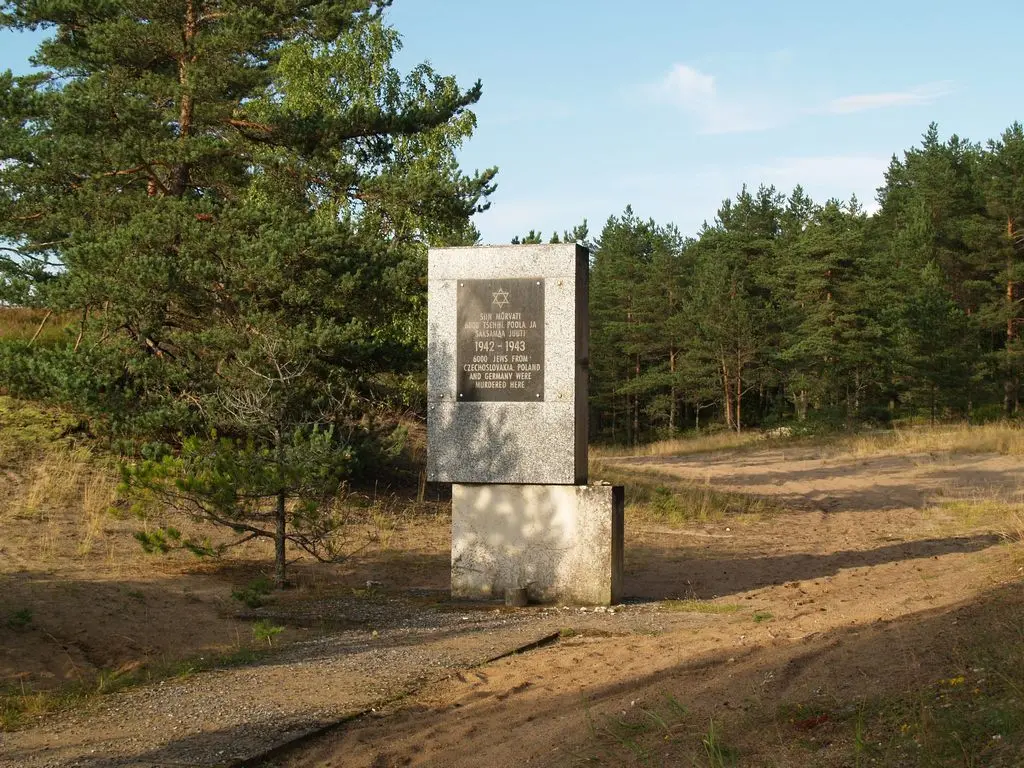
A monument erected by the Jewish Community of Estonia in 1995–1996 stands at the Kalevi-Liiva killing site, and an information board was renovated in 2002 with support from the Czech, German and Polish embassies. A commemoration is held there every year on 5 September.
Sources
- Estonian Memory Institute: Jägala camp and execution site at Kalevi-Liiva Theresienstadt train with 1,002 Jews arrived 5 Sept 1942; Frankfurt/Berlin train with 1,049 (or 1,089) arrived 30 Sept 1942; c. 400 selected for Jägala; nearly 1,600 shot at Kalevi-Liiva; Roma victims; bodies burned 1944; camp closed 1 Sept 1943; 74 survivors of more than 2,000
- Historische Kommission zu Berlin: Die Transportliste des 20. Osttransports nach Raasiku Departure 26 Sept 1942 from Moabit freight station after Levetzowstraße; 812 Berliners plus 237 from Frankfurt; via Riga; Raasiku c. 35 km from Tallinn; c. 100–150 women and 50 men selected; others taken by bus to Kalevi-Liiva and shot by Estonian police; Helga Drexler's survival
- Statistik des Holocaust: 20. Osttransport Departure 26 Sept 1942; 809 Berlin deportees, total 1,043 including 234 from Frankfurt; many families with children
- Jewish Museum in Prague: Estonia (Paths of No Return) Transport Be with 1,001 prisoners left Terezín 1 Sept 1942 for Raasiku; killings at Kalevi-Liiva
- European Jewish Congress: Commemoration at Kalevi-Liiva Monument erected 1995–1996 by the Jewish Community of Estonia; info board renovated 2002; concealment attempts; graves discovered 1961; annual 5 September ceremony
- Jewish Community of Estonia: Holocaust in Estonia Estimate of 3,000–6,000 killed at Kalevi-Liiva; graves discovered 1961
- Gleis 69: Der Deportationsbahnhof Transport to Raasiku left Moabit 24/26 Sept 1942, arrived 30 Sept 1942
- Wikipedia: Kalevi-Liiva coordinates (59.4803833 N, 25.2498444 E)