Riga
Ghetto, killing site, concentration camp, 1941–1944. Today Riga (Rīga), Latvia.
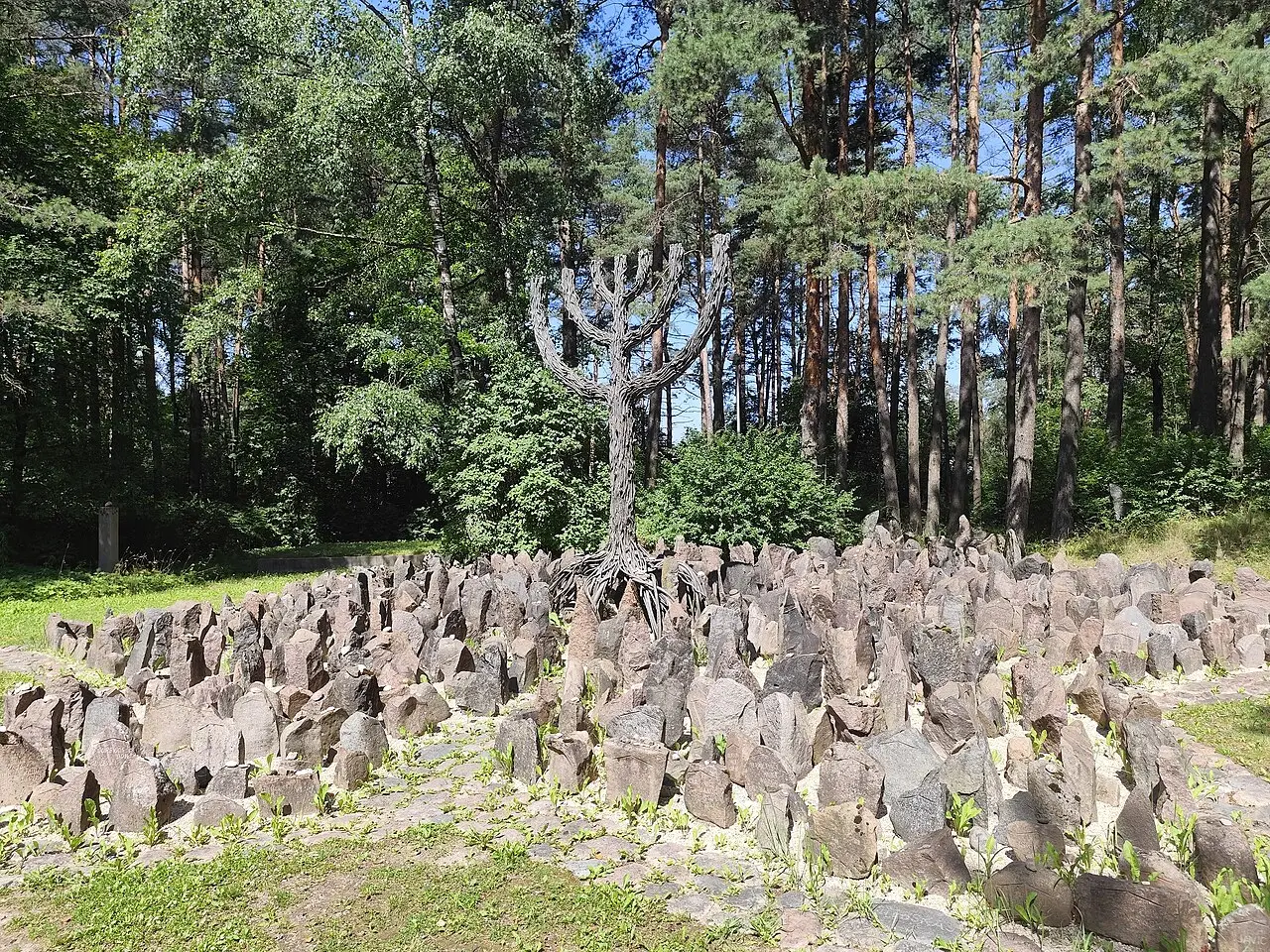
German forces occupied Riga, the Latvian capital, in early July 1941. In mid-August 1941 the occupation authorities created a ghetto in the southeastern part of the city and sealed it in October; about 30,000 Jews were confined there. On 30 November and 8–9 December 1941, German SS and police units together with Latvian auxiliaries shot at least 25,000 of the ghetto's inmates in the Rumbula forest outside the city (USHMM; the German Riga Committee gives 26,500, Yad Vashem more than 27,500).
The massacres were carried out to clear space for Jews deported from the German Reich. According to USHMM, some 20,000 Jews from Germany, Austria and the Protectorate of Bohemia and Moravia were deported to Riga; the German Riga Committee speaks of more than 25,000 people in 33 transports between November 1941 and the winter of 1942. Some arrivals were held at Jungfernhof, a run-down farm estate, most in a separate "German" section of the ghetto, while the surviving Latvian Jews were confined to a "small ghetto". Many deportees were murdered on arrival or in later selections. In the Biķernieki forest at least 35,000 people – Jews from Latvia and from the Reich, political prisoners and almost 10,000 Soviet prisoners of war – were shot and buried in 55 mass graves.
In March 1943 the SS established the Kaiserwald concentration camp, to which ghetto inmates were moved in the summer of 1943; the ghetto was liquidated in December 1943 and surviving prisoners were later sent to Stutthof. Soviet troops took Riga on 13 October 1944; almost all of Riga's Jews had been murdered. The map marker for this entry shows the Rumbula killing site, where the first transport from Berlin was murdered on arrival.
From Berlin
Eight transports went from Berlin to Riga. The first left Grunewald station on 27 November 1941 with 1,053 men, women and children and reached Skirotava station near Riga on 30 November. That same day all of its passengers were shot in the Rumbula forest – the first victims of the massacre that day, killed even before the Jews of the Riga ghetto; Heinrich Himmler afterwards voiced his displeasure at this "unauthorized action". Three further trains left Grunewald on 13, 19 and 25 January 1942, each carrying about 1,000 people, many of them elderly (average ages between 55 and 60). The journeys took place in severe frost, partly in unheated freight cars, and some deportees died on the way. On arrival at Skirotava, elderly, sick and frail people were taken away and murdered in gas vans or at Rumbula; the others were marched into the ghetto, where many later fell victim to selections such as the so-called "Aktion Dünamünde" in spring 1942. Historians count only between six and 19 survivors for each of these three transports.
From August to October 1942 four more transports left Berlin, now from the Moabit freight station on Putlitzstraße/Quitzowstraße: on 15 August (up to 1,004 people), on 31 August or 5 September (790–804 people; the sources differ on the date), on 19 October (about 960 people, including more than 200 children) and on 26 October 1942 (about 800 people, among them at least 204 employees of the Berlin Jewish community and their families, the so-called "Gemeindeaktion"). Apart from small groups of men selected for forced labour (80 from the September transport, 81 from the 19 October transport), the deportees were shot in the Rumbula and Biķernieki forests shortly after arrival. Historian Wolfgang Scheffler, cited by Yad Vashem, counted one survivor of the 15 August transport, six of the September transport and 17 of the 19 October transport; no survivors are known from the transport of 26 October 1942.
8 transports from Berlin brought 7,655 people here; at least 58 of them are known to have survived.
Transports from Berlin to Riga
| Date | Designation | From | People | Known survivors |
|---|---|---|---|---|
| 27.11.1941 | VII. Transport | Bahnhof Grunewald | 1,053 | |
| 13.01.1942 | VIII. Transport | Bahnhof Grunewald | 1,036 | 15 |
| 19.01.1942 | IX. Transport | Bahnhof Grunewald | 1,009 | 19 |
| 25.01.1942 | X. Transport | Bahnhof Grunewald | 1,000 | |
| 15.08.1942 | 18. Osttransport | Güterbahnhof Moabit | 1,004 | 1 |
| 31.08.1942 | 19. Osttransport | Güterbahnhof Moabit | 790 | 6 |
| 19.10.1942 | 21. Osttransport | Güterbahnhof Moabit | 963 | 17 |
| 26.10.1942 | 22. Osttransport | Güterbahnhof Moabit | 800 |
The memorial today
A memorial ensemble at Rumbula opened on 29 November 2002 on the site of the mass graves, and in the Biķernieki forest a memorial of some 5,000 granite stones was inaugurated on 30 November 2001 by the Volksbund together with the cities of the German Riga Committee. The Riga Ghetto and Latvian Holocaust Museum documents the history of the ghetto.
Sources
- USHMM Holocaust Encyclopedia: Riga Occupation July 1941; ghetto established mid-August, sealed October 1941, c. 30,000 inmates; Rumbula 30 Nov and 8–9 Dec 1941, at least 25,000 shot; some 20,000 Reich/Austrian/Czech Jews deported to Riga; small and German ghetto; Kaiserwald March 1943; ghetto liquidation December 1943; Stutthof; liberation 13 October 1944
- Yad Vashem, Transports to Extinction: Transport Da 31 from Berlin to Riga, 27/11/1941 1,053 deportees from Grunewald; arrival Skirotava 30 Nov; all shot at Rumbula on 30 Nov before the Riga Jews; Himmler's reaction; Jungfernhof; more than 27,500 shot at Rumbula; 1,047 names in Berlin memorial book
- Yad Vashem: Transport 8 (Da 44) from Berlin to Riga, 13/01/1942 1,034 deportees, average age 60; selections on arrival, gas vans and Rumbula; Aktion Dünamünde; survivors 10 (Meyhöfer) or 15 (Scheffler)
- Yad Vashem: Transport 9 from Berlin to Riga, 19/01/1942 995–1,002 deportees in box cars, average age 55; deaths en route; survivors 9 (Meyhöfer) or 19 (Scheffler)
- Yad Vashem: Transport 10 from Berlin to Riga, 25/01/1942 1,044 deportees, average age 58; people froze to death en route; survivors 6 (Meyhöfer) or 13 (Scheffler)
- Yad Vashem: Transport 18 (Da 401) from Berlin to Riga, 15/08/1942 Departure from Moabit freight station (Putlitzstraße/Quitzowstraße); up to 1,004 deportees; shot at Rumbula and Biķernieki; one survivor (Scheffler)
- Yad Vashem: Transport 19 (Da 403) from Berlin to Riga, 05/09/1942 Date given as 5 September 1942; up to 804 deportees; 80 men selected for labour, six survived; others shot 8 September
- Yad Vashem: Transport 21 from Berlin to Riga, 19/10/1942 Up to 962 deportees including 209 children; 81 men selected for labour; 17 survivors (Scheffler); others shot at Rumbula and Biķernieki
- Yad Vashem: Transport 22 from Berlin to Riga, 26/10/1942 Up to 798 deportees, at least 204 Jewish community employees ("Gemeindeaktion"); all shot on arrival
- Statistik des Holocaust: Berlin transport list Dates and deportee figures of the eight Berlin–Riga transports (VII–X, 18, 19, 21, 22)
- Statistik des Holocaust: 19. Osttransport Gives departure 31 August 1942 (Gestapo letter dated 5 September) and 790 Berlin deportees – conflicts with Yad Vashem's 5 September
- Deutsches Riga-Komitee: Deportation jüdischer Bürger nach Riga More than 25,000 Jews in 33 transports Nov 1941–winter 1942; 26,500 Latvian Jews killed at Rumbula; selections in Jungfernhof and ghetto
- Volksbund: Bikernieki At least 35,000 buried in 55 mass graves incl. almost 10,000 Soviet POWs; memorial of 5,000 granite stones inaugurated 30 November 2001 with Riga Committee cities
- Jewish Community of Latvia: Rumbula Memorial More than 25,000 killed; about 1,000 Jews from Germany among them; memorial complex opened 29 November 2002
- Riga Ghetto and Latvian Holocaust Museum: About Museum on the Riga ghetto and the Holocaust in Latvia
- Wikipedia: Rumbula massacre coordinates (56.88556 N, 24.24583 E)
.jpg)