Sachsenhausen (Oranienburg)
Concentration camp, 1936–1945. Today Oranienburg, Germany.
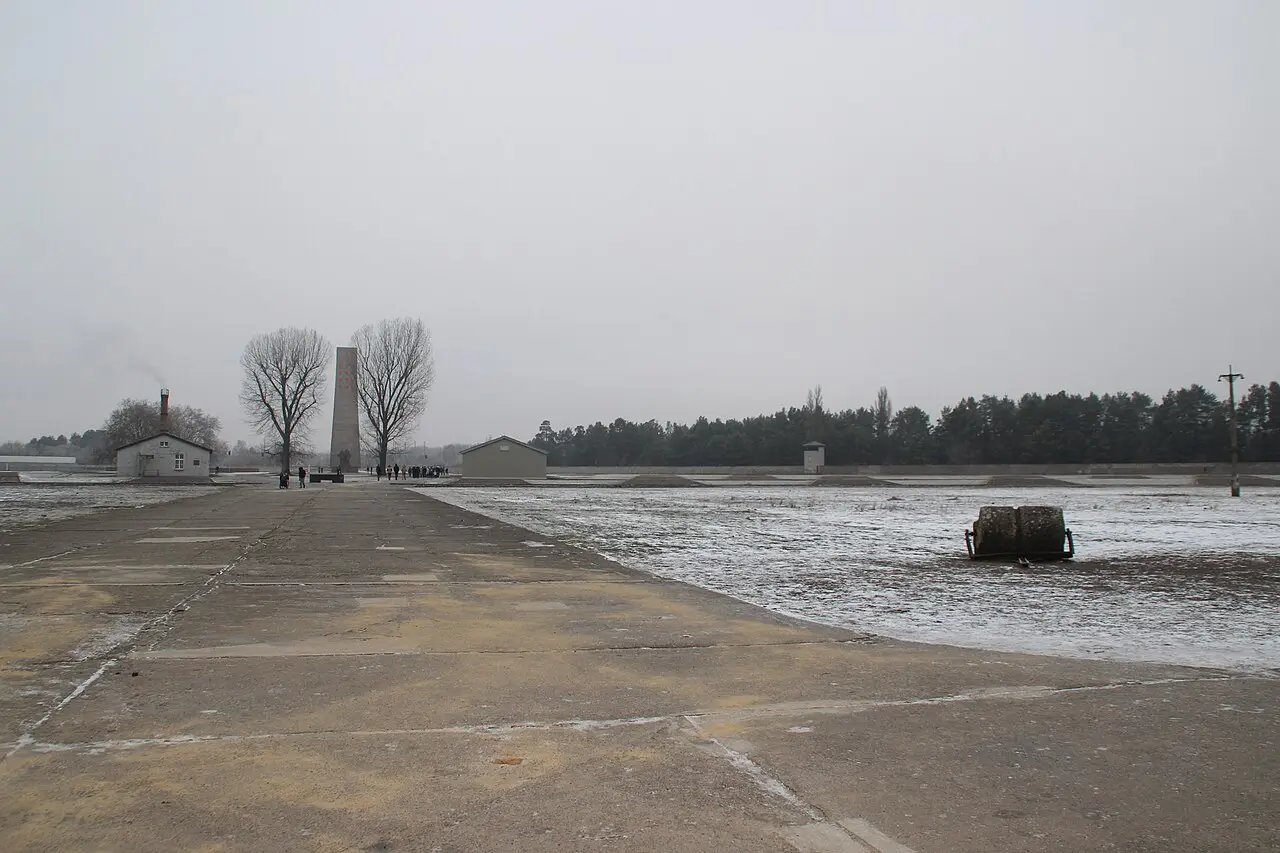
Sachsenhausen, near Oranienburg just north of Berlin, was opened by the SS on 12 July 1936. The number of Jewish prisoners ranged from 21 in early 1937 to 11,100 at the beginning of 1945; about 6,000 Jews were brought to the camp in the days after the November pogrom of 1938. By the end of October 1941 the SS had deported about 12,000 Soviet prisoners of war to Sachsenhausen; estimates of the number of Soviet prisoners of war killed there range from 11,000 to 18,000 (USHMM).
In May 1942 the SS began using a newly built execution facility in the camp, and a gas chamber was added in 1943. Jewish prisoners were deported from Sachsenhausen to camps in occupied Poland, most often Auschwitz, as part of the effort to make the Reich "judenfrei". By mid-January 1945 more than 65,000 prisoners, including more than 13,000 women, were held in the Sachsenhausen camp complex.
In the night of 20–21 April 1945 the SS forced 33,000 prisoners onto death marches to the northwest; guards shot those who could not keep up. On 22 April 1945 units fighting under Soviet command liberated about 3,000 prisoners who remained in the camp. The SS interned an estimated 200,000 people in Sachsenhausen. A Soviet commission put the number of deaths at over 100,000; according to the USHMM, newer research gives a more realistic estimate of 30,000 to 50,000. The memorial's book of the dead lists the names of 20,500 prisoners who died in the camp and its satellite camps.
From Berlin
Sachsenhausen was closely tied to the persecution of Berlin's Jews. On 18 May 1942 resistance fighters, among them the group around Herbert Baum, attacked the Nazi propaganda exhibition "Das Sowjetparadies" in the Lustgarten. In reprisal, the Gestapo arrested several hundred Jews in Berlin as "hostages" on 27 May 1942 (about 500 according to Yad Vashem; more than 400 men according to a report in the Berliner Zeitung). On 28 and 29 May 1942 the camp SS shot 250 Jewish men at Sachsenhausen in its new execution facility: 154 of the Berlin hostages and 96 Jewish men already imprisoned in the camp. The Stiftung Denkmal describes the killings as an example staged by Himmler and Goebbels to show the Jews still living in Berlin how resistance would be punished, and as the beginning of the last phase of the destruction of the German Jews. According to the Berliner Zeitung, another 250 of the men arrested in Berlin were committed to Sachsenhausen as "Schutzhäftlinge"; in the following months they were worked to death or murdered, and the last survivors were deported to Auschwitz and murdered there in October 1942, when the camp was made "judenfrei". Relatives of the murdered men – 89 relatives of 53 of the victims – were deported to Theresienstadt on 5 June 1942.
At the very end of the deportations, with the Red Army advancing, the last small "Osttransporte" from Berlin were sent to Sachsenhausen. According to the Arolsen Archives, the 60th and 61st transports (December 1944 and January 1945) certainly went there, with the women sent on to Ravensbrück, while it is uncertain whether the 59th (24 November 1944) reached Auschwitz or was diverted to Sachsenhausen. The list after Gottwaldt and Schulle gives 15 and 30 people for the 60th and 61st transports; the Statistik des Holocaust list records four transports (59th–62nd, November 1944 – February 1945) to Ravensbrück/Sachsenhausen with 15 to 28 people each.
4 transports from Berlin brought 439 people here; at least 10 of them are known to have survived.
Transports from Berlin to Sachsenhausen
| Date | Designation | From | People | Known survivors |
|---|---|---|---|---|
| 28.05.1942 | Not documented | 154 | 0 | |
| 29.05.1942 | Not documented | 250 | ||
| 08.12.1944 | 60. Osttransport | Not documented | 15 | 2 |
| 05.01.1945 | 61. Osttransport | Not documented | 20 | 8 |
The memorial today
The site became the GDR's third national memorial in 1961; today the Memorial and Museum Sachsenhausen commemorates the camp's prisoners, with a book of the dead in its exhibitions, and also documents the Soviet special camp that existed there from 1945 to 1950.
Sources
- USHMM Holocaust Encyclopedia: Sachsenhausen Opened 12 July 1936 near Oranienburg; Jewish prisoners from 21 (early 1937) to 11,100 (early 1945); about 6,000 Jews after Kristallnacht; about 12,000 Soviet POWs by end of October 1941, 11,000–18,000 killed; Jewish prisoners deported mostly to Auschwitz to make the Reich 'judenfrei'
- USHMM Holocaust Encyclopedia: Sachsenhausen – Conditions in the Camp Gas chamber built 1943; more than 65,000 prisoners incl. more than 13,000 women in mid-January 1945
- USHMM Holocaust Encyclopedia: Sachsenhausen – Liberation and Postwar Trials Death march of 33,000 prisoners 20–21 April 1945; liberation of about 3,000 on 22 April 1945; estimated 200,000 prisoners; deaths: Soviet estimate over 100,000, newer research 30,000–50,000
- Memorialmuseums.org: Memorial and Museum Sachsenhausen GDR national memorial 1961; death book with 20,500 names; Soviet special camp 1945–1950; official website
- Stiftung Denkmal für die ermordeten Juden Europas: »Todesursache: Auf Befehl erschossen.« 250 Jewish men shot by camp SS on 28–29 May 1942; trigger was the Baum group's attack of 18 May 1942 on 'Das Sowjetparadies'; Himmler and Goebbels' intent; beginning of the last phase
- Berliner Zeitung: Als die Nazis 250 Berliner Juden für eine Widerstandsaktion ermordeten (13 April 2022) Arrest of more than 400 Jewish men on 27 May 1942; 154 shot in the new execution facility, plus 96 camp prisoners; 250 others held as 'Schutzhäftlinge', worked to death or murdered, last survivors deported to Auschwitz in October 1942; 89 relatives of 53 victims deported to Theresienstadt on 5 June 1942
- Yad Vashem: Transport I/3 from Berlin to Theresienstadt, 05/06/1942 About 500 Jews taken hostage on 27 May 1942; 154 shot plus 96 already imprisoned; family members sent to Theresienstadt
- Arolsen Archives: Deportations from Berlin (1.2.1.1, VCC 155 I) 59th transport possibly diverted to Sachsenhausen; 60th and 61st certainly to Sachsenhausen, women onward to Ravensbrück
- Bezirksamt Charlottenburg-Wilmersdorf: Liste der Deportationszüge aus Berlin von 1941 bis 1945 (after Gottwaldt/Schulle) 60th (15 people) and 61st (30 people) transports to Sachsenhausen
- Statistik des Holocaust: Deportationslisten Berlin 59th–62nd Osttransporte to Ravensbrück/Sachsenhausen, 15–28 people each
- Wikipedia: Sachsenhausen concentration camp coordinates