Warschau (Ghetto)
Ghetto, 1940–1943. Today Warsaw, Poland.
German officials ordered the creation of a ghetto in occupied Warsaw in October 1940 and sealed it off from the rest of the city in November 1940, behind a wall almost three metres high topped with barbed wire. At its height more than 400,000 Jewish people were confined to about 3.4 square kilometres (1.3 square miles), on average more than seven people to a room.
Living conditions were catastrophic. In 1941 official food rations came to about 1,125 calories a day, and according to the United States Holocaust Memorial Museum (USHMM) some 83,000 Jews died of starvation and disease between 1940 and mid-1942. Between April and July 1942 Jews from Germany and from German-occupied western Poland were also deported into the ghetto.
From 22 July to 21 September 1942 German SS and police units, supported by non-German auxiliaries, deported about 265,000 Jews from the ghetto to the Treblinka killing centre (USHMM; Jewish Council statistics give 254,000), and about 35,000 more were killed in the ghetto during this operation. In January 1943 roughly 5,000 more people were deported to Treblinka and 1,171 were shot. The Warsaw Ghetto Uprising began on 19 April 1943; by 16 May the SS and police had destroyed the ghetto. About 7,000 Jews died fighting or in hiding, about 7,000 were deported to Treblinka and about 42,000 to concentration and forced-labour camps.
From Berlin
Two deportation trains from Berlin are documented as going to the Warsaw ghetto, both leaving from the Moabit freight station. The first left on 2 April 1942 (Reich Association correspondence gives 3 April for the Berlin deportees) and reached Warsaw on 5 April. The Bundesarchiv chronology gives 984 or 1,025 deportees; statistik-des-holocaust.de, working from the Gestapo lists, counts 643 people from Berlin and 366 from the Frankfurt (Oder) administrative district, and notes that nearly half of those deported had been taken from forced-labour camps, including 63 from Neuendorf, a former Jewish training farm turned into a forced-labour camp in 1941. Adam Czerniaków, chairman of the Warsaw Jewish Council, recorded in his diary the arrival of 1,025 deportees from Berlin. According to a Berlin Stolperstein biography, the train had been scheduled to go to Trawniki near Lublin and was diverted to Warsaw. A second train left on 14 April 1942 and arrived on 16 April; it carried Jews mainly from the Potsdam and Magdeburg regions together with 65 people from Berlin who had first been held at the Levetzowstraße synagogue (938 deportees in all according to statistik-des-holocaust.de, about 1,000 according to the Bundesarchiv). The Berlin list based on Gottwaldt and Schulle gives Warsaw or Auschwitz as the uncertain destination of a further train on 11 July 1942; statistik-des-holocaust.de lists that train as the first Berlin transport to Auschwitz.
Berlin memorial biographies describe what followed: the deportees were housed in overcrowded rooms in the ghetto, where many died of hunger and disease, and from July 1942 most ghetto residents were deported to Treblinka and murdered. Selma Franziska Israel, deported on 2 April 1942, was most likely murdered at Treblinka at the age of 62; the fate of Gertrud Friedländer, deported the same day, is not known.
2 transports from Berlin brought 708 people here; at least 1 of them are known to have survived.
Transports from Berlin to Warschau
| Date | Designation | From | People | Known survivors |
|---|---|---|---|---|
| 03.04.1942 | XII. Transport | Güterbahnhof Moabit | 643 | 1 |
| 14.04.1942 | XIII. Transport | Güterbahnhof Moabit | 65 |
The memorial today
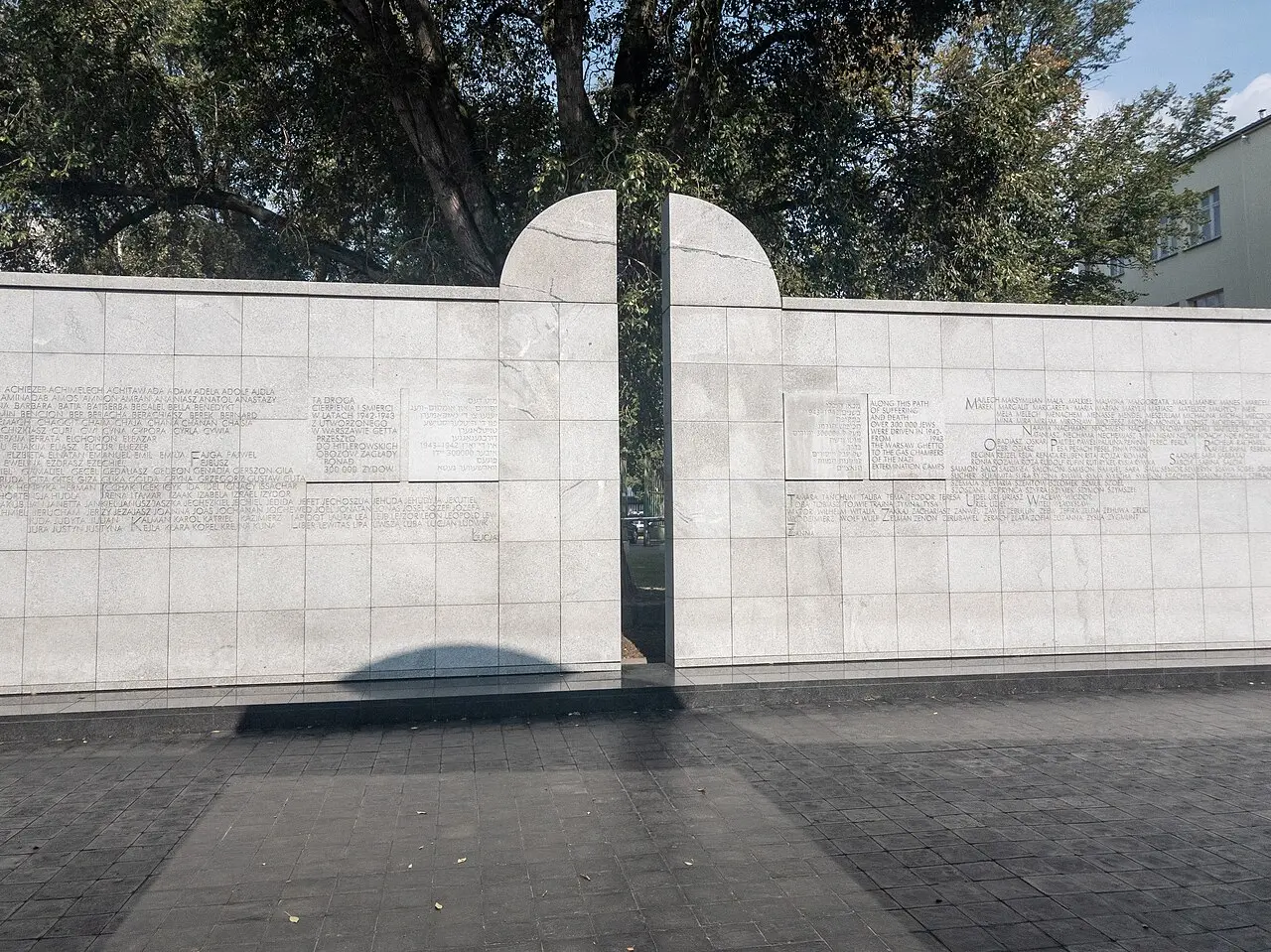
The Umschlagplatz Memorial on ul. Stawki, unveiled in 1988 and designed by Hanna Szmalenberg and Władysław Klamerus, marks the place from which ghetto residents were deported to Treblinka. The POLIN Museum of the History of Polish Jews stands in the area of the former ghetto, facing the Monument to the Ghetto Heroes.
Sources
- USHMM Holocaust Encyclopedia: Warsaw Establishment (October 1940) and sealing (November 1940) of the ghetto, wall, area, population, density, rations, 83,000 deaths, July–September 1942 deportations (about 265,000) and about 35,000 killed in the ghetto, uprising dates
- USHMM Holocaust Encyclopedia: Deportations to and from the Warsaw Ghetto Deportations of Jews from Germany into the ghetto April–July 1942; January 1943 deportations (about 5,000; 1,171 shot); outcome of the April–May 1943 liquidation (about 7,000 killed, 7,000 to Treblinka, 42,000 to camps)
- Bundesarchiv Gedenkbuch: Chronologie der Deportationen aus dem Deutschen Reich Berlin–Warschau 2 April 1942 (984/1,025 deportees, arrival 5 April) and Magdeburg–Potsdam–Berlin 14 April 1942 (1,000, arrival 16 April)
- Statistik des Holocaust: XII. Transport (Berlin, April 1942) 643 deportees from Berlin and 366 from the Frankfurt/Oder district; date 3 April in Reich Association correspondence; Czerniaków diary entry of 5 April 1942; deportees from forced-labour camps including Neuendorf
- Statistik des Holocaust: XIII. Transport (Berlin, 14 April 1942) 65 deportees from Berlin, 427 from Potsdam district, 446 from Magdeburg/Anhalt (938 total); Berlin deportees held at the Levetzowstraße synagogue; arrival in Warsaw 16 April
- Gleis 69: Der Deportationsbahnhof Both April 1942 Warsaw transports departed from the Moabit freight station
- Bezirksamt Charlottenburg-Wilmersdorf: Liste der Deportationszüge aus Berlin 1941–1945 List based on Gottwaldt/Schulle: transport of 11 July 1942 with uncertain destination (Warschau or Auschwitz)
- Statistik des Holocaust: Deportationslisten Berlin First Berlin transport to Auschwitz on 11 July 1942
- Bezirksamt Charlottenburg-Wilmersdorf: Stolpersteine Trautenaustr. 8 (Selma Franziska Israel) Train of 2 April 1942 diverted to the Warsaw ghetto instead of Trawniki; most ghetto residents deported to Treblinka from 22 July 1942; Franziska Israel most likely murdered in Treblinka
- Bezirksamt Charlottenburg-Wilmersdorf: Stolpersteine Schlüterstraße 54 (Gertrud Friedländer) Gertrud Friedländer deported 2 April 1942 to the Warsaw ghetto; overcrowding; her fate unknown
- Memorial Museums: Umschlagplatz Memorial Memorial inaugurated 1988, designers, address; 254,000 deported in summer 1942 according to Jewish Council statistics
- POLIN Museum: The Building Museum located in the former ghetto area, facing the Monument to the Ghetto Heroes
- Wikipedia: Umschlagplatz coordinates